
News (866)
Children categories
ES! Initiatives (74)
EarthSolidarity!™ Initiatives are endeavors to which anyone can contribute in deed as well as in spirit, that
- minimize waste and environmental impacts
- increase community resilience
- respect and protect ecosystem processes and all forms of life
- contribute to good living conditions for everyone around the globe
- affirm and celebrate our interdependence and interrelatedness in the Web of Life!

Compass: Three Rivers Market bosses supported union status
Managers of a North Central Street grocery cooperative in Knoxville known for its selection of quality and local organic goods agreed to “voluntary recognition” of a union agreed to by 73 percent of its workers, according to Compass.
Union members agreed to join United Food and Commercial Workers (UFCW) Local 1995, according to Compass, which reported that manager Jacqueline Arthur said “Three Rivers Market deeply respects our employees‘ right to join a union.”

Dollywood joins Tennessee Aquarium effort to limit the introduction of cigarette butts to our shared waterways.
“As all humans need access to clean water, it’s an incredibly important treasure to protect.” — Dr. Anna George, Tennessee Aquarium vice president of conservation science and education.
Cigarette butts are everywhere, and are perhaps so familiar they go unnoticed by the millions of people who pass them on our streets and roads.
Not only are they unsightly, they contaminate our water resources — the puddles after a sudden rainstorm, the streams that flow through our landscapes, and the stormwater drains that ultimately lead to the Tennessee River. The butts quickly break down, polluting water with “tiny plastic fibers and a devil’s cocktail of chemical compounds,” according to the Tennessee Aquarium.
Environmental groups allege TVA misused funds to fight pollution regulations
Written by Thomas FraserAssociated Press: Activists say TVA spent ratepayer money to sue over pollution restrictions
A coalition of environmental groups alleges the Tennessee Valley Authority provided millions of dollars in dues to a trade group resistant to air-pollution control measures.
TVA officials say the utility's membership in the Utility Air Regulatory Group was a way to help it navigate the complexities of federal pollution regulations, but documents obtained by the clean-air coalition via a Freedom of Information Act request show the now-disbanded trade group spent $3.5 million on legal fees between 2015 and July 2018. TVA CEO Jeff Lyash told Congress in 2019 the utility had paid UARG $7.3 million since 2001.
The committee that approved the legal expenses was co-chaired at the time by a senior TVA manager, and in lawsuits, "the UARG frequently argued against tighter air pollution and climate regulations," according to the AP.
The Knoxville-based Southern Alliance for Clean Energy was among the environmental groups calling for a review of TVA's relationship with the UARG and other trade groups.
(SACE executive director Stephen Smith is a member of the board of Foundation for Global Sustainability. Hellbender Press is a self-supporting project of FGS).
All forward: Tennessee RiverLine paddle trail offers world-class recreation and reconnects the valley with its river heritage
Written by Thomas Fraser
RiverLine dedicates itself to recreation and retrospect on the storied Tennessee River
In many respects, the United States and Native American nations before it were carved out by paddle blades.
Rivers provided transportation, communications, sustenance and avenues for exploration. They were the genesis of cities large and small.
Americans grew apart from the rivers that watered and nurtured a modern nation, their connections cut by outward growth and industrial development along riverbanks.
Only recently have the great continental rivers again become the centerpieces of redevelopment and modern recreation. One such effort officially launched in Knoxville on May 21 aims to further connect communities in four states with their river again.
A bale of turtles watched from logs embedded in the sediment of the Tennessee River (or more precisely, Fort Loudoun Lake) at Suttree Landing Park near downtown as officials from Knoxville to Paducah, Kentucky celebrated the creation of the Tennessee RiverLine, which will establish continuous paddling, hiking and biking trails along the 652-mile length of the reservoir-regulated river.
The initial effort, which will include enhanced launch and takeout sites, signage and navigational aids, 60 publicly available kayaks, campground enhancement, and publicity, is largely funded by a $400,000 investment shared between the University of Tennessee and Tennessee Valley Authority. The National Park Service is also a partner in the project.
Seventeen private and public groups of the RiverLine Partnership are committed to furthering the development of the trail, including the Nature Conservancy. Other supporters include Muscle Shoals National Heritage Area and the Tennessee Aquarium in Chattanooga.
“These partners have brought so much to the city of Knoxville,” said Mayor Indya Kincannon specifically of UT and TVA during her public remarks at the well-choreographed event in the well-groomed park with the downtown skyline visible under a clear, blue sky to the northwest.
“The Tennessee RiverLine is a continuation of our vision for what makes a healthy city: (which includes) parks and recreation,” she said, also touting the economic, therapeutic and spiritual benefits of ready access to outdoor recreation.
“During this past year, we’ve had a really hard time, dealing with the pandemic, and one thing that has helped me, and so many members of this community, is being able to be outside: being on the river, being in our parks,” Kincannon said.
“That has helped us get through some challenging times, and that’s going to help us into the future.”
 Eva Millwood holds Brood X cicadas on her property in South Knoxville in this submitted photo.
We will see a groundswell of East Tennessee 17-year cicadas as the heat comes on.
We have been hearing about it for weeks, online and on TV and in print. After 17 years underground, millions of cicadas are going to climb out of their burrows, shed their juvenile skins, unfurl their wings and fly up into the trees for one last grand jester of panache and reproduction and death. You even read about Brood X cicadas in Hellbender Press.
The Tennessee Wildlife Resources Agency posted a recent Instagram photo of a wild turkey jake with a crop stuffed full of cicadas, and there are reports of cicadas emerging en masse in parts of Tennessee. But your local searching self may ask: Where are they?
Insects are largely ectothermic. That means their body temperature comes from the surrounding air, water or ground temperature. The periodical cicadas need a ground temperature of roughly 68 degrees, eight inches deep to become very active. And we really have not had that for a sustained length of time.
Last week seemed to be destined to be the first big week of the emergence of Brood X. Monday started strong but the weather turned unusually cool for early May with daytime highs in the low 60s. Some of the cicadas started to ease out but it was primarily dozens, not hundreds or thousands, and certainly not 1.5 million per occupied acre. And remember, they are not everywhere.
Great Smoky Mountains National Park announces new deputy superintendent
Written by Thomas FraserGreat Smoky Mountains National Park on Monday announced that Alan Sumeriski, a veteran park infrastructure manager in the nation's most-visited national park, will take the helm as deputy superintendent.
“Alan is a well-respected senior leader in the National Park Service with over 30 years of experience in managing some of the most complex operations in the National Park Service and I’m honored to select him as the next deputy superintendent of the Smokies,” Superintendent Cassius Cash said in a press release announcing Sumeriski's new assignment. “As acting deputy superintendent, Alan has consistently provided strong and innovative parkwide leadership to help us meet the challenges of today and tomorrow.”
Sumeriski has served as the heavily visited national park's facilities management chief since 2007. His first assignment was as an engineering equipment operator for park service units in the Washington/Baltimore area.
“Alan provides leadership for over 150 permanent and seasonal staff who care for 384 miles of roads, 146 bridges, 152 historic cemeteries, 27 water and sewer systems, 10 campgrounds, 11 picnic areas, 848 miles of trails, and over 100 historic structures and landscapes,” according to a park release.
Face your fears: It’s time to have a global conversation about spider conservation
Written by John R. Platt U.S. Fish and Wildlife Service biologist Susan Cameron searches moss mats for the spruce-fir moss spider in this USFWS photo.
European spidey senses should give us pause across the pond.
This story was originally published by The Revelator.
Despite their enormous ecological values, new research reveals we don’t understand how most arachnid species are faring right now — or do much to protect them.
Spiders need our help, and we may need to overcome our biases and fears to make that happen.
“The feeling that people have towards spiders is not unique,” says Marco Isaia, an arachnologist and associate professor at the University of Turin in Italy. “Nightmares, anxieties and fears are very frequent reactions in ‘normal’ people,” he concedes.
100-year NOAA interactive climate map illustrates changes in temperatures, precip over time
Written by Thomas FraserNYT: NOAA map details US climate change over last century
The map produced by the National Oceanic and Atmospheric Administration shows that virtually all of the U.S. has higher average temperatures than 100 years ago. The precipitation data shows where rainfall averages have increased (East Tennessee and most of the Appalachian Mountains and their adjacent foothills and valleys) and where they fluctuated beyond average (California and the Southwest). Some of the data predates the regular government weather and climate record-keeping that began 90 years ago.
"Because the normals have been produced since 1930, they also say a lot about the weather over a much longer term. That is, they show how the climate has changed in the United States, as it has across the world, as a result of emissions of heat-trapping gases over more than a century."
Help tip the scales toward environmental justice for all: Here’s how
Written by Appalachian VoicesMake your voice heard for environmental justice
The White House Environmental Justice Advisory Council is seeking public input on a series of recommendations to the Biden Administration to address environmental justice issues across the United States. Air and water pollution caused by coal mining, toxic coal ash spills, and natural gas pipelines are a few examples of such problems in our region. These issues often impact low-income people and people of color the most, and there is a strong need for communities impacted by fossil fuels to build vibrant, diversified economies.
This is a chance for you to communicate your concerns about how these environmental issues impact disadvantaged communities while important policy decisions are under development!
The council will meet on May 13 to discuss:
-
Environmental justice policy recommendations to Congress and the Biden Administration;
-
A new Climate and Economic Justice Screening Tool, which will help identify disadvantaged communities and target federal funding;
-
Updates to a Clinton-era Executive Order (EO 12898) which directed federal agencies to address environmental justice issues in Black and Brown communities and among low-income populations.
Public comments will be accepted in writing until May 27. To submit a written comment, email This email address is being protected from spambots. You need JavaScript enabled to view it. .
Register to attend the meeting or submit your comment today!
Public comments will help to inform the future work of the White House Environmental Justice Advisory Council, and they will be incorporated into the record for federal agencies’ consideration.
Wildlife rehabbers return birds to the sky in Chattanooga
Written by Ray Zimmerman
Restoring wings to rise above the Earth again
“I think the most amazing and rewarding thing about raptor rehab is taking a bird that's literally at death's door to a full recovery and then releasing her back to her wild home.” Alix Parks, Wildlife rehabilitator
Alix Parks became a certified wildlife rehabilitator 25 years ago. Her new career was sparked by a class in wildlife rehabilitation at the University of Tennessee at Chattanooga taught by Debbie Lipsey.
Parks also counts Lynne McCoy and Katie Cottrell of the Clinch River Raptor Center as early mentors. At first, she prepared food for the animals and worked with any animal brought to her. She is now a certified rehabilitator and has specialized in birds of prey for 16 years.
- wildlife rescue
- chattannoga wildlife rescue
- injured bird
- injured wildlife
- what do i do with injured wildlife
- chatanooga
- university of tennessee at chattanooga
- wildlife rehabilitation
- national wildlife rehabilitators association
- international wildlife rehabilitation council
- happinest wildlife rehabilitation and rescue
- chattanooga zoo
- raptor
- young bird
KCM Knoxville Community Media Engagement Calendar
Knoxville Community Media (KCM)
KCM’s Community Engagement Calendar provides information about both, date-specific events and the regular programs & services provided by nonprofit organizations.
Many people still think it is necessary to have a TV cable connection to watch community TV programs. But that’s old history.
One does not even need to be in the City of Knoxville or anywhere near it, nor have a TV set anymore.
Natural 911: Knoxville Native Plant Rescue Squad whisks threatened plants to safety
Written by Thomas Fraser Joy Grissom (left) and Gerry Moll pose for a photograph with their collection of rescued native plants at Knoxville Botanical Gardens. Photos by Anna Lawrence/Hellbender Press
Joy Grissom and Gerry Moll: Preserving East Tennessee’s natural heritage with shovels and wheelbarrows
If there’s a massive ecological disturbance in your neighborhood, who you gonna call?
The Knoxville Native Plant Rescue Squad, of course.
Joy Grissom and Gerry Moll spent the past six years identifying, digging, hauling and muscling native East Tennessee plants to salvation from construction, grading and logging sites.
The duo has saved thousands of plants and their communities from certain demise. They have plucked plants to safety from areas ranging from a 170-acre logging operation in Cocke County to relatively small commercial developments in Knox County.
- knoxville native plant rescue squad
- ecology
- habitat
- garden
- plant rescue
- tree rescue
- planting
- knoxville botanical garden and arboretum
- preservation
- east tennessee
- natural heritage
- knox county
- developer
- land owner
- contractor
- forever home
- farmers market
- salvage
- eastern band of cherokee indians
- knox county schools
EPA to announce stricter regulations on HFC emissions
Written by Thomas FraserNYT: EPA plans stricter regulation of HFC emissions
Hydrofluorocarbons were used on an industrial scale to replace ozone layer-destroying chlorofluorocarbons used in refrigeration, cooling and other applications, but they turned out to be a powerful driver of climate change. Scientists estimate HFCs are 1,000 times more potent than carbon dioxide in terms of their cimate-change role.
Oak Ridge National Laboratory scientists continue research into zero-emission refrigerant technologies.
According to Times reporting: “In proposing a new regulation, Michael S. Regan, the E.P.A. administrator, said the agency aimed to reduce the production and importation of hydrofluorocarbons, which are used in refrigeration and air-conditioning, in the United States by 85 percent over the next 15 years.”
It’s Epic: 7,500-acre Roan Mountain wild land donation largest in North Carolina history
Written by Thomas FraserCItizen Times: Roan Mountain donation will protect vast stretches of forest in Roan Highlands
Epic Games CEO Tim Sweeney donated 7,500 acres to the Southern Appalachian Highlands Conservancy, an area described by an Asheville Citizen-Times reporter as “A high-elevation hideaway for birds, bears and salamanders, a massive piece of Western North Carolina’s famous mountains left unmarred, and a refuge for rare species in the face of climate change...
“The property includes the largest American Chestnut restoration project in the country, extensive boulder fields, rich coves, old growth forests, six waterfalls, and a system of rare heath balds,” according to Citizen-Times reporter Karen Chavez.
The land area is at least equivalent to the size of some highland state parks.
Knoxville Mayor Indya Kincannon’s budget calls for $30m in environmental-improvement measures
Written by Thomas Fraser
Mayor wants green for green; some otherwise supportive city residents already aren’t pleased with some initiatives.
KNOXVILLE — Mayor Indya Kincannon’s proposed Knoxville 2020-2021 budget commits some $30 million to reduce city climate impacts, expand its use of renewable energy, invest in urban forest preservation and outdoor recreation assets and improve bus and bicycle travel in communities across the city. The budget also provides money for revitalization of the Burlington District, a historic pedestrian center of Black commerce in East Knoxville.
The city’s net budget is $384 million, which includes a $253 million operating fund.
The budget is just a recommendation to City Council at this point.
More...
Nuclear energy update
Sep 13 Noon EST
Current Issues in the Nuclear Field
Richard H “Chip” Lagdon Jr.
Technical Society of Knoxville (TSK)
Zoom Webinar — Free and open to the public — advance registration required
Richard Lagdon is Professor of Practice in Nuclear Engineering at the University of Tennessee. He also is Engineering Manager, Systems Integration and Chief Engineer, Nuclear Operations & Safety with Bechtel National Inc. Reston, VA.
He will review the status of current projects for Natrium and VTR fast reactors, the challenges of advanced reactor licensing and how the development of the Nuclear Licensing Course NE486/586 at UT reckons with these challenges.
He has forty years of progressive nuclear experience managing projects, developing technical policy, interfacing with stakeholders and developing long range plans. He is an accomplished nuclear professional, practiced in engineering, emergency operations, plant startups and conduct of operations while supporting operational goals.
From working as Shift Test Engineer for the reactors of the nuclear Navy to developing life cycle maintenance plans for aircraft carriers, Captain Lagdon’s broad range of assignments over 30 years in the Navy Reserves, earned him the Leo Bilger award for outstanding leadership. The civilian side of his career included a decade as Chief of Nuclear Safety in the U.S. Department of Energy, where he lead nuclear construction reviews for projects totaling more than $15 billion.
While some hope that nuclear energy will end the climate crisis others point out that it will be too expensive and take too long to scale up while climate disasters grow exponentially. What most can agree upon is that the reliable output of existing nuclear plants remains indispensable for the foreseeable future and that maintaining their safety is paramount.
The webinar organized by the Technical Society of Knoxville, which provides Professional Development Hour confirmation to attending professional engineers, is hosted by the Foundation for Global Sustainability (FGS).
FGS facilitates educational events to inform the public and foster better understanding of complex environmental, social and economic issues that impact the resilience of communities and the natural life support systems of planet Earth. Views and opinions expressed by event organizers and participants do not necessarily reflect the views of FGS. FGS neither endorses any product or service mentioned nor warrants for accuracy, completeness or usability of the information.
Technical Society of Knoxville Centennial Celebration
Jun 14 6:30 p.m. EST
The Turning Point: Things were never the same after 1921, when technology was changing the city in several surprising ways
Jack Neely, Executive Director of the Knoxville History Project
Technical Society of Knoxville (TSK)
Charity Banquet at Crowne Plaza for the Charles Edward Ferris Engineering Endowments at University of Tennessee, Knoxville - the public is invited - RSVP by June 8
Ferris was the first Dean of UTK’s College of Engineering.
More details on the event, sponsorships, and reservations
The Technical Society of Knoxville was founded in 1921. It has met over 4,000 times to discuss the application of technology from early Knoxville’s coal smoke and traffic problems to present Knoxville’s transportation air pollution and the impact of electric car technologies.
ORNL scientists fan out to local schools and bring their research home during National Environmental Education Week
Written by Karen Dunlap Students listen to a presentation from an Oak Ridge National Laboratory researcher during National Environmental Education Week. Courtesy Oak Ridge National Laboratory
Scientists link research to students’ lives and communities
(Editor’s note: Karen Dunlap is a public information officer at Oak Ridge National Laboratory).
Esther Parish is one of eight Oak Ridge National Laboratory scientists talking to students in nine schools across East Tennessee as part of National Environmental Education Week.
On Monday, she spoke to Cathy Kimball’s fifth-grade class at Lenoir City Middle School.
The discussion covered renewable energy resources, science career paths and how climate change may affect East Tennessee.
Other ORNL scientists, including Debjani Singh, Liz Agee, Shelaine Curd, Spencer Washburn, Colleen Iversen, Keith Kline and Matthew Langholtz are participating in classroom events through April 30.
The national event is organized by the National Environmental Education Foundation (NEEF), which celebrates environmental education.
“I think it is important to reach out to young people about environmental science because the choices that our society makes regarding renewable energy resource development and climate-change mitigation will have long-term effects on their environment, health and future quality of life,” Parish said. She is a member of ORNL’s Environmental Science Division and specializes in geography and landscape ecology.
Volunteers remove 15 tons of trash from Tennessee River
Written by Thomas Fraser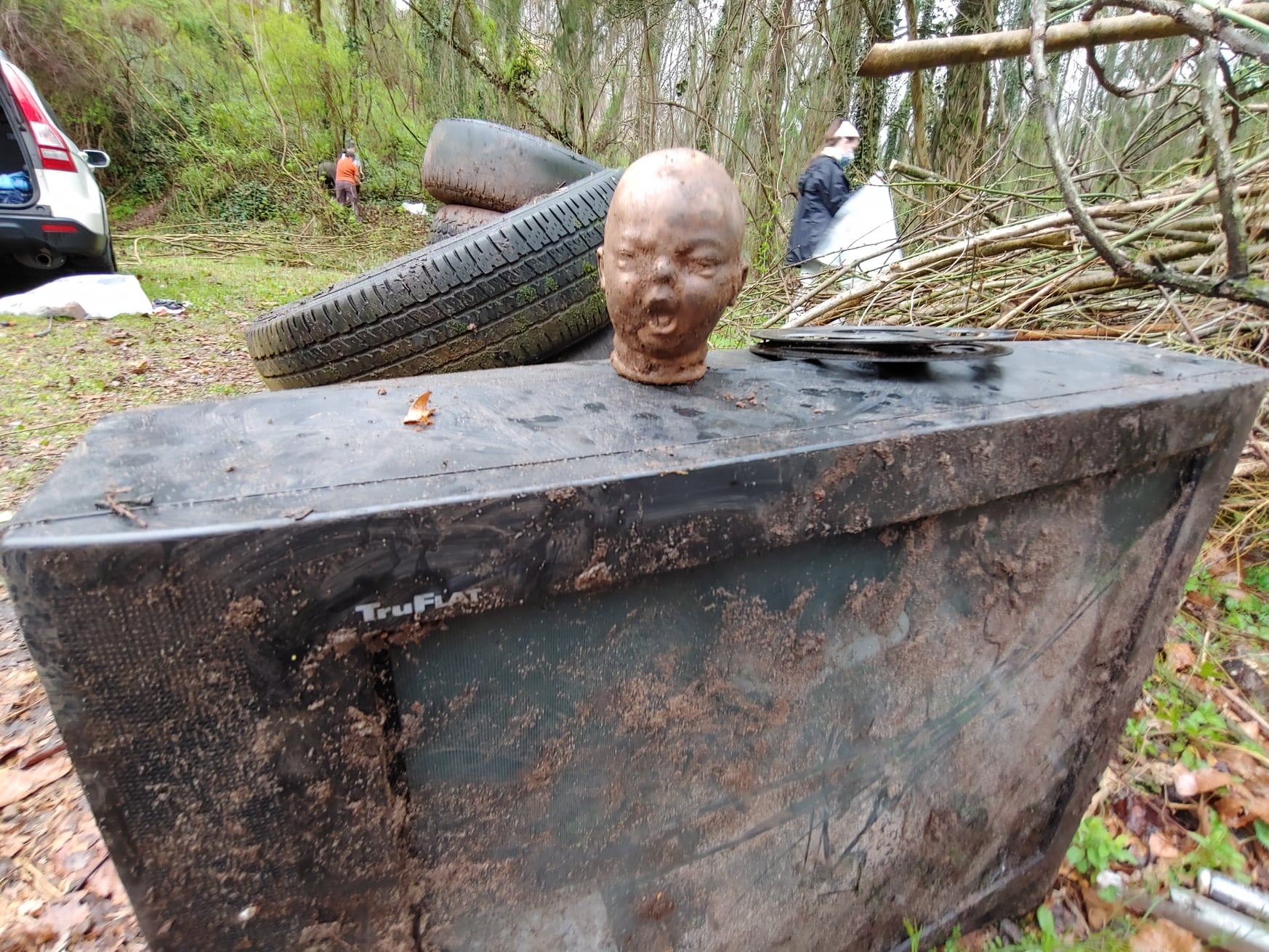 This photo provided by Ijams Nature Center is an example of the plethora of weird things removed from the Tennessee River and its tributaries during the annual River Rescue held March 27.
Mattresses, rocking horse and plastic shed among the stranger items retrieved from area waterways
Volunteers removed 31,000 pounds from the Tennessee River and its watersheds on March 27 during the 32nd annual Ijams River Rescue despite a storm system that dropped several inches of heavy rain on the area.
The rain dissuaded some of the 717 volunteers signed up for the river rescue, but nearly 500 people still joined together to collect trash from 32 sites. Their nasty haul included 919 bags of garbage and 82 tires, according to a release from Ijams Nature Center.
The heavy rain actually worked out somewhat in organizers’ favor, as debris and flotsam were flushed from tributaries into the main stem of the river.
“Heavy rain always means more trash because the rising waters wash everything downstream and into the Tennessee River,” Ijams Volunteer Coordinator Madelyn Collins said in the news release. “We are so appreciative to everyone who braved the storms and did the work while they could. It was amazing how much volunteers accomplished in such a short time.”
One lucky participant found a $50 bill; other unusual items removed from the river included a toilet, a recliner, mattresses, a rocking horse, plastic shed and a baby stroller.
“The takeaway from this year’s event—and every other cleanup this community does—is that we need to be more careful about how we dispose of trash and recyclables. If you don’t put it where it belongs, it ends up in our water.”
Tennessee Valley Authority; city of Knoxville Stormwater Engineering; Bio Plumbing, LLC; First Horizon Foundation; Tennessee Wildlife Resources Agency; WestRock CP, LLC; Genera, Inc.; Knoxville TVA Employees Credit Union; Waste Connections of Tennessee Inc.; CAC AmeriCorps; and the Water Quality Forum sponsored, supported or participated in the annual cleanup.